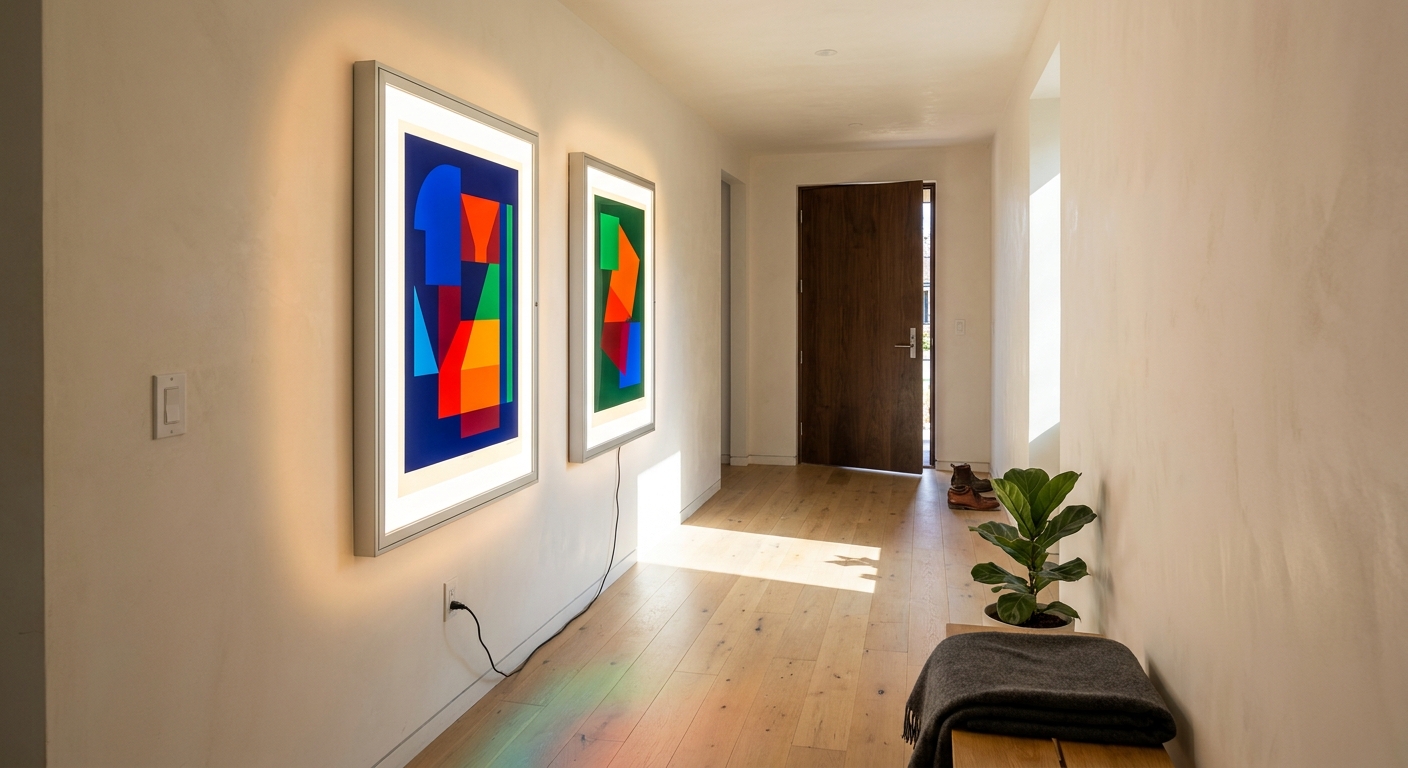
The screen gets all the budget. The projector, the seating, the acoustic treatment, the subwoofer placement — most home theater builds spend their attention on the room where the movie plays. Then the owner walks down the hallway leading into it and realizes the approach to the room feels like any other basement corridor.
A movie poster light box is the detail that closes that gap. It is the single most recognizable piece of cinema furniture outside the auditorium itself, and it is also one of the least expensive upgrades in the entire build. Done properly — sized to the space, dimmable, and mounted at the right height — an illuminated poster frame turns a corridor into an entrance. Done poorly, it's a glowing rectangle with a hot spot in the middle and a poster that took twenty minutes and a screwdriver to change.
This guide covers what actually matters when you're specifying one.
Why an Illuminated Frame Beats a Printed Poster
An unlit poster behind glass depends entirely on the room's ambient light. In a home theater hallway, that light is deliberately dim — which means the poster is dim too. Backlighting solves the problem by making the graphic its own light source.
There's a second, less obvious benefit. A movie poster light box does double duty as low-level architectural lighting. In a media room corridor you generally want just enough illumination to move safely without washing out the transition into a dark room. An illuminated frame dimmed to a third of its output handles that job better than a ceiling fixture, because the light is diffuse, low, and comes from the wall plane rather than overhead.
That's why dimming isn't a nice-to-have here. Every Prime Light Boxes unit is fully dimmable and works with a standard wall dimmer or a remote-controlled dimmer, so you can run the frame bright when you're showing the room off and drop it to a glow during a film.
Sizing: Start With the Poster, Not the Wall
The standard theatrical one-sheet is 27" × 40". Most people build around that dimension, and it's a reasonable default — it's what studio posters and reproduction prints are sold in.
But "standard" is where a lot of installs go wrong. A 27" × 40" frame in a wide hallway looks undersized. A pair of them on a narrow wall looks crowded. And if you're framing something that isn't a one-sheet — a custom print, a bank poster at 40" × 60", vintage lobby cards, or a graphic your designer produced at an arbitrary size — a fixed frame simply won't fit it.
Prime Light Boxes builds custom sizes only. There is no standard catalogue to compromise against: you give us the exact outside dimensions or the exact graphic size, and the frame is manufactured to it. Practically, that means you can plan the wall first and order the frame second, rather than the other way around.
A few sizing rules that hold up in most home theaters:
- Single feature frame: leave at least 12" of clear wall on each side. If you can't, the wall wants a smaller frame, not a tighter margin.
- Pairs or a run of three: keep the gaps between frames equal and smaller than the side margins. Uneven spacing reads as a mistake even when nobody can say why.
- Mounting height: center the frame at roughly 60" from the finished floor — the same eye-line convention galleries use. In a theater hallway with seating nearby, drop it slightly.
Snap Frames vs. Sealed Displays
If you plan to change the poster — and in a home theater you almost certainly will, seasonally or whenever a new favourite comes out — the mechanism matters more than anything else on the spec sheet.
LED snap frames use front-loading aluminum profiles. All four sides hinge open, the graphic drops in behind a protective lens, and the sides snap shut. No tools, no dismounting the frame, no reaching behind anything. A swap takes under a minute and can be done by one person on a step stool.
The alternative — a sealed backlit display where the graphic is bonded or rear-loaded — makes sense for permanent signage that will never change. For a media room, it's the wrong choice. You'll regret it the first time you want to put something new up.
Snap frames start at $280 and scale with size. For a larger, frameless look with a fabric graphic instead of a printed sheet, fabric light boxes are the other option worth pricing — the silicone-edge graphic gives a cleaner, borderless face at 2" or 3" depth.
What "Even Illumination" Actually Means
The cheapest illuminated frames put an LED strip along one edge and call it done. The result is a bright band near the strip fading to grey at the far edge — obvious on any poster with a large flat area of colour, which is most of them.
Even illumination comes from two things: LED placement and diffusion. Prime Light Boxes builds its frames so that output is spread across the full face — a 27" × 40" poster should read as bright in the middle as it is at the border. On large formats, where lighting from the perimeter alone can't carry the distance, backlit light panels run LED bars throughout the panel body instead — the same principle, scaled up, with no size limit.
Ask any supplier for a photograph of an illuminated frame with a solid white graphic in it. Hot spots and edge fade have nowhere to hide on white.
The Specification Details Worth Confirming
Before ordering any illuminated frame, confirm these — from us or from anyone else you're quoting:
Certification. Every Prime Light Boxes product is CSA/UL certified. In a residential build this matters for insurance and for any inspection the theater work triggers; in a commercial screening room it isn't optional.
Power supply. Ours ships with every unit — a UL/ETL-approved supply sized with 20% extra capacity, never sold separately. Extra headroom means the supply isn't running at its limit, which is the usual reason budget fixtures fail early.
LED life and warranty. The LEDs are rated for 50,000+ hours, and every product carries a 3-year warranty. At four hours a day, 50,000 hours is over three decades of use — this is a fixture you install once.
Depth and mounting. Confirm the frame's profile depth before you finalize wall treatment. Acoustic panelling, fabric-wrapped walls, and shadow-gap details all interact with how a frame sits, and it's much easier to plan for than to retrofit around.
Lead time. Most orders ship in 1–2 weeks, and smaller frames can go out in as little as two days. Rush production is available on request — worth knowing if the theater has a completion date attached to it.
A Word on Where It's Built
Every frame is designed and manufactured in-house at our facility in Richmond Hill, Ontario. Not assembled from imported components — manufactured, to your dimensions, by the people you can call at 416.269.0447 if something isn't right. Shipping is free within Canada, and orders ship duty-free and tax-exempt to the US under CUSMA.
That directness is most of the point. A custom size is only useful if the person cutting the aluminum can be reached when the measurement needs to change.
Putting It Together
The best home theater entrances share a pattern: one or two illuminated frames at eye level, sized generously for the wall, dimmed low, with everything else in the corridor kept dark. It reads as intentional immediately, and it costs a fraction of what most people assume.
Measure your wall, decide how many frames it wants, and specify from there. If you're not sure what size the space can carry, send us the dimensions and a photo — we'll tell you what we'd build.