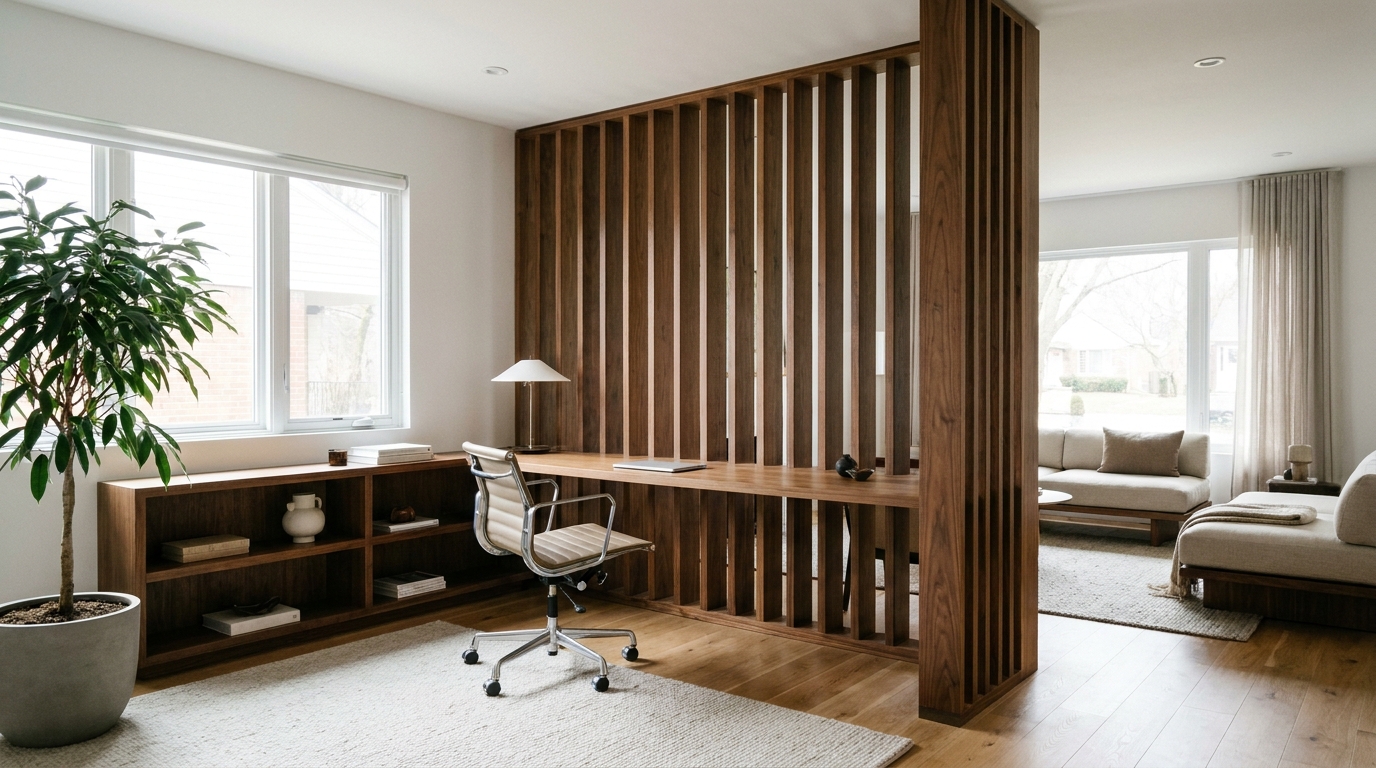
Most homeowners planning a wood slat room divider spend their time comparing finishes — walnut against white oak, veneer against paintable MDF — and only think about slat profile as an afterthought. That's a mistake. The slat profile, meaning the actual width and depth of each individual slat's cross-section, has more influence on how a divider reads in a room than almost any other spec. Primo Panels offers three standard profiles — 2"x4", 2"x5", and 2"x6" — and each one changes the divider's visual weight, the privacy it creates, and what it costs.
What Slat Profile Actually Means
Profile refers to the dimensions of the wood as seen face-on: a 2"x4" slat is 2 inches deep and 4 inches wide, a 2"x6" is 2 inches deep and 6 inches wide, and so on. All three profiles come in the same finishes — Walnut, Dark Walnut, White Oak, Unfinished/Stainable, and Paintable — and work with either the ROTERA rotating system or the FIXERA fixed system. The profile is a separate decision from finish and system, but it's the one that determines how much of the room behind the divider actually shows through.
Every profile is available in lengths from 8ft to 12ft, and Primo Panels' Build and Price tool lets you model wall width, ceiling height, and gap spacing against any of the three before you commit to an order.
2x4: The Standard Choice
The 2"x4" profile is the most common starting point, and for good reason. At 4 inches wide, individual slats are narrow enough that a divider reads as light and airy rather than solid — you get zone definition without the room feeling walled off. It suits living rooms, entryways, and staircases where the goal is separating space visually while keeping sightlines and natural light moving through. Pricing starts at $130 CAD for an 8ft Walnut, Dark Walnut, or White Oak slat in this profile, or $90 CAD for Paintable MDF.
2x5: The Middle Ground
The 2"x5" profile splits the difference. It has more visual presence than a 2x4 without tipping into the bolder, more architectural feel of a 2x6. This is the profile designers reach for when a room needs a divider that reads as a genuine furniture-grade feature — not just a light screen — but the space still calls for some openness behind it. It works especially well in home offices and bedroom zone dividers, where a bit more coverage helps with both visual privacy and a sense of enclosure at a desk or headboard wall.
2x6: The Bold Statement Profile
At 6 inches wide, the 2"x6" profile is the most substantial of the three. Slats at this width create a divider with real architectural presence — closer to a slatted wall than a screen — and noticeably more coverage between each gap. This is the profile to choose in larger rooms, taller ceilings, or spaces where the divider is meant to be a focal point rather than a subtle transition. A 12ft Walnut FIXERA divider in this profile runs about $265 CAD, reflecting both the larger cross-section and the additional material per slat.
How Profile Affects Privacy, Light, and Cost
Wider profiles mean less open space between slats at the same gap setting, which means more visual privacy and slightly less light transfer through the divider — an important tradeoff to model with the Build and Price tool before ordering. Wider profiles also use more material per linear foot, which is reflected in the price difference between a 2x4 and a 2x6 divider of the same length and finish. If acoustic separation matters as much as visual separation — a common request from homeowners dividing a home office from a living space — a wider profile paired with tighter slat spacing will do more work than a narrow profile alone.
Matching Profile to Room Scale and Ceiling Height
Profile should scale with the room, not just the look you like in a photo. In a smaller room or one with standard 8ft ceilings, a 2x4 or 2x5 profile tends to keep the divider proportionate to the space. In great rooms, open-concept main floors, or spaces with vaulted or sloped ceilings, a 2x6 profile holds its own visually across a taller run of slats without looking undersized. Homeowners working with vaulted ceilings should also review Primo Panels' custom bracket options, since profile choice and ceiling geometry are typically decided together.
Profile Works With Either System
Whichever profile you choose, it pairs with both installation systems Primo Panels offers: ROTERA, where slats rotate for adjustable light and privacy, and FIXERA, where slats are fixed in place. Profile size is independent of that decision — a 2x6 divider can be built as either a rotating or fixed installation, and the same is true at 2x4 and 2x5. Every profile is designed for permanent, professional installation, glued or screwed to ceiling and floor as a lasting architectural feature of the home.
For homeowners still deciding between finishes and systems, primopanels.com's Build and Price tool is the fastest way to see how a 2x4, 2x5, or 2x6 profile will actually look and cost in your specific room before ordering.
Choosing With Confidence
There's no universally "correct" profile — the right choice depends on room size, how much privacy you need, and whether you want the divider to recede into the space or become its focal point. What matters is treating profile as a deliberate design decision alongside finish and system, not an afterthought decided at checkout. A 2x4 wood slat divider and a 2x6 wood slat divider in the same Walnut finish can read as two completely different pieces of furniture in a room, and getting the scale right the first time means a permanent feature you'll be glad you invested in for years to come.