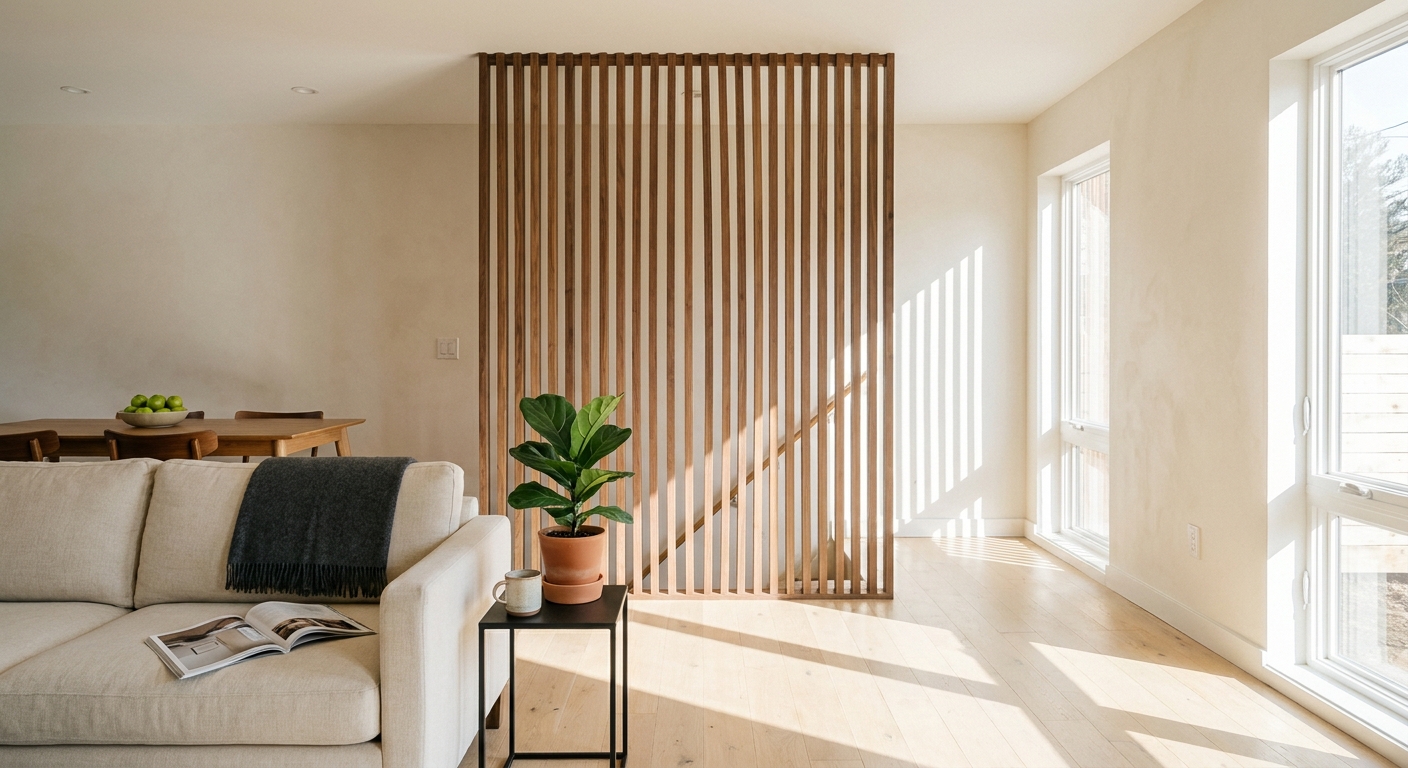
Every interior upgrade eventually gets asked the same question: what happens to it when you sell? Most answers are disappointing. Furniture leaves with you. Paint gets repainted. A freestanding screen is a possession, not an improvement, and nobody has ever valued a house higher because of one. So it is a fair question to put to a wood slat room divider before you commit — does a permanently installed divider actually do anything for resale value, or is it a personal indulgence you write off on move-out day?
The honest answer has two halves, and they work differently. Appraisers value built-in millwork one way. Buyers respond to it another way, and far more strongly. Understanding both is what separates a divider that pays you back from one that simply looks nice for a few years.
How Appraisers Treat Built-In Millwork
An appraiser working a residential sale is fundamentally a comparison machine. They find comparable recent sales in your area and adjust up or down for differences. There is no line item on any appraisal form that says "slat divider," and there never will be. What exists instead are two categories that a permanently installed divider legitimately lands in.
The first is quality of construction and finish. Appraisers grade interiors on a scale — builder-grade, above average, custom. Real wood veneer millwork, precisely fitted floor to ceiling, moves a room up that scale in the same way solid-core doors, custom cabinetry or genuine hardwood trim do. It is not a dollar-for-dollar credit, but it contributes to the overall grade assigned to the property, and that grade is applied across the whole square footage.
The second is functional utility. Appraisals account for how a floor plan works. A four-bedroom home appraises above a three-bedroom home of identical size. In the same way, an open plan where a defined home office, a screened entry or a separated dining zone genuinely exists is a more functional plan than one big undifferentiated room — and permanent architecture is what creates that distinction. A folding screen does not; it is furniture, and appraisers ignore furniture entirely.
That word permanent is doing real work here. This is the line that determines whether the improvement counts at all. A SKANDINAVIA divider is fixed to the ceiling and the floor as a structural element of the room. It is part of the house. That is precisely why it gets considered, and why anything that lifts out and walks away does not.
What Buyers Actually Respond To
Appraisals set the financing ceiling. Buyers set the price. And buyers do not think in adjustment grids — they think in first impressions, and those impressions are almost entirely architectural.
Listing agents have understood this for a long time. The features that photograph well and hold attention in the first ten seconds of a showing are the ones that create depth, rhythm and warmth. A floor-to-ceiling run of vertical walnut slats, catching daylight and throwing a striped shadow across the floor, does all three. It gives a listing photograph a foreground, a middle ground and a background instead of a flat wall. It signals, before anyone reads the spec sheet, that this house was designed rather than merely built.
There is a practical dimension too. Open-plan homes are the dominant stock in most North American markets, and their most common complaint is the absence of edges — nowhere to work, nowhere to put a desk that does not sit in the middle of the living room, no separation between the front door and the sofa. A divider that solves that problem while a buyer is standing in the room is worth more than any amount of copy in the listing. You are not selling a decorative feature. You are selling a floor plan that works.
Compare that with the alternatives buyers meet all the time. A half wall reads as unfinished builder framing. A glass partition reads as an office fit-out. A curtain reads as a stopgap. Wood slats read as intentional joinery, which is the register you want a house to speak in when someone is deciding whether to bid.
Specifying a Divider That Holds Its Value
Not every installation contributes equally. A few decisions determine whether a divider still reads as an asset to a stranger walking through in five years.
Choose the finish for longevity, not for a moment
The finishes that age best are the ones that read as materials rather than as trends. Pre-finished Walnut and Dark Walnut veneer bring amber-to-caramel depth that suits mid-century, Japandi and contemporary interiors alike. White Oak is the lighter, airier choice and the safest neutral in a bright room. All three are genuine wood veneer, not a printed lookalike, which matters enormously when a buyer runs a hand across it. A paintable high-density MDF option exists for interiors where the divider should recede into a colour scheme, and an unfinished stainable option lets a finisher match existing floors or trim exactly. Matching what is already in the room is one of the strongest signals that the divider was designed in rather than added on.
Let the divider look built, not applied
Floor-to-ceiling is the specification that reads as architecture. A partial-height screen reads as a fixture. Slat cross-sections run 2"×4" as standard, 2"×5" for a mid-weight presence and 2"×6" when you want the divider to carry real architectural mass. Lengths run 8ft through 12ft, with custom cross-sections and cut-to-length available, and dedicated brackets for vaulted or sloped ceilings — so the divider terminates cleanly against the actual ceiling plane rather than stopping short of it. The details at the top and bottom are what a discerning buyer notices first.
Pick the system for the space, not the showroom
FIXERA fixes the slats in position and is the right call when you want the divider to behave unambiguously as architecture. ROTERA lets each slat rotate, so the same divider closes to a near-solid plane for privacy and opens to an almost transparent screen for light. In a home office carved out of a living room, ROTERA demonstrates flexibility during a showing in a way a static partition cannot — a buyer turns the slats, watches the room change, and understands the value immediately.
Put it where the plan is weakest
The highest-return placements are the ones that fix a genuine floor plan deficiency: an entry that opens directly into the living room, a work zone with no boundary, a dining area that bleeds into a kitchen, a stair landing exposed to the main space. Dividing a room that was already fine adds decoration. Resolving a plan that was not adds function, and function is what gets valued.
The Cost Side of the Equation
Pricing is straightforward and worth putting on the table. SKANDINAVIA dividers are sold per slat with a 12-slat minimum. Pre-finished veneer starts at $130.00 CAD per 8ft 2"×4" slat, with paintable MDF from $90.00 CAD, running up to $265.00 CAD for a 12ft 2"×6" slat. Shipping to the USA and Canada is a flat $400 fee that includes handling, customs and brokerage — no surprise duties on arrival — and there is no sales tax on US orders. The Build and Price Your Divider tool at primopanels.com takes your wall width, ceiling height, finish, system and gap spacing and returns an exact slat count and price, which is the number you want before you make any resale calculation at all.
Set against a half wall — framing, drywall, tape, mud, primer, paint, a cap detail, two trades and several days — a slat divider is competitive on cost and considerably better on outcome. And unlike a decorative purchase, it stays with the property.
Samples ship free in every finish, which is the sensible first step: real veneer next to your actual floors, in your actual light, before you specify. Defective slats are replaced under our faulty slat replacement guarantee, but the product itself is designed as a permanent fixture — installed once, into a home you intend to keep improving.
So, Does It Add Value?
Directly, in appraisal terms: modestly, through construction quality and floor plan functionality, alongside the rest of your interior. Indirectly, in market terms: considerably more, because it changes how a house presents and how quickly a buyer can picture living in it.
The clearer way to think about it is this. A wood slat divider is not an expense you hope to recover — it is millwork you get to live with for a decade or more, in a home that works better the whole time you own it, and that shows better on the day you list it. Very few interior purchases can claim both.
If you are weighing it against another way to divide the space, the deciding question is simple: will it still be part of the house when you hand over the keys? Permanently installed wood slat dividers are. That is where their value comes from.