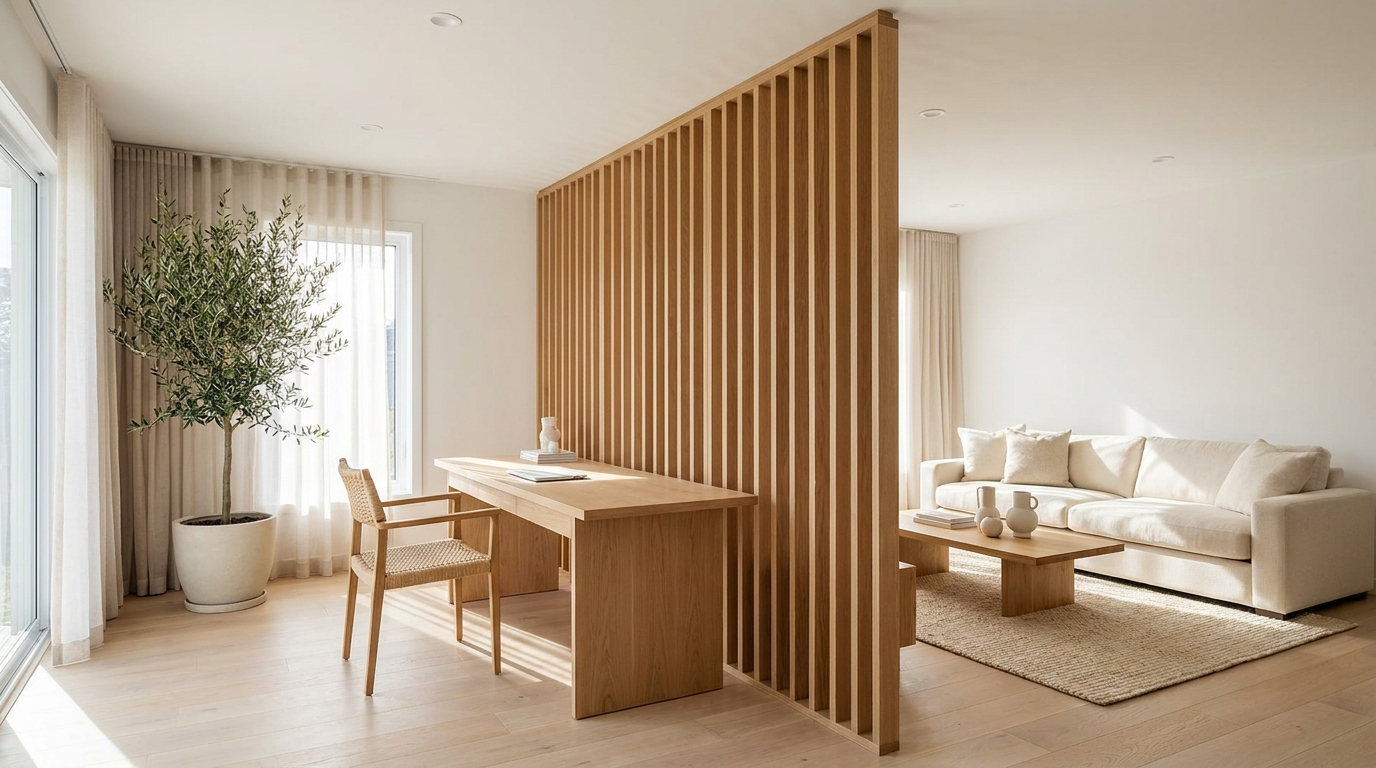
Choosing a slat panel finish comes down to one early decision that shapes everything else about the project: do you want the material itself to be the feature, or do you want it to disappear into your color scheme? That's the real difference between wood veneer and paintable MDF slat dividers, and it's worth settling before you start measuring walls.
Both are legitimate, professional-grade options for a permanent wood slat room divider. Neither is the "budget" choice or the "upgrade" — they're built for different design goals. Here's how to tell which one fits your room.
What Wood Veneer Slat Dividers Actually Are
Pre-finished veneer slats are built from a genuine wood veneer layer over a stable core, finished and ready to install. In finishes like Walnut, Dark Walnut, and White Oak, the grain, color variation, and depth you see are real wood characteristics — not a printed pattern. No two slats are identical, and that's the point: it's what gives a wood slat room divider its warmth and texture in person, in a way that's hard to replicate with a flat surface.
Veneer finishes work best when the wood itself is meant to read as a design statement — a focal wall in a living room, a staircase feature, a divider that's meant to be the first thing you notice when you walk into an open-plan space. They pair naturally with Scandinavian, mid-century modern, and Japandi interiors, where warm, natural material tones do a lot of the visual work.
What Paintable MDF Slat Dividers Actually Are
Paintable slats are milled from high-density MDF (medium-density fiberboard) — a smooth, stable, paint-ready surface with none of the grain or color variation of natural wood. Instead of choosing a wood tone, you choose (or custom-match) any paint color: matte black for a moody accent wall, a soft warm white to blend into existing trim, or a bold color that wood veneer simply can't offer.
This is the finish to reach for when the divider needs to integrate into an existing color palette rather than introduce a new material story. It's also the more forgiving option in rooms where the divider will be touched up or repainted down the line as the rest of the space evolves — the surface takes paint cleanly and holds a crisp, consistent finish across every slat, since there's no natural grain variation to work around.
Comparing the Two Head-to-Head
Appearance. Veneer shows authentic wood grain and natural color variation, slat to slat. MDF gives you a uniform, smooth surface in any paint color — including finishes wood veneer can't produce, like true black or saturated hues.
Design flexibility. Veneer locks you into a wood-tone palette (Walnut, Dark Walnut, or White Oak). Paintable MDF is color-flexible for the life of the installation — repaint it to match a future renovation without replacing the dividers.
Texture and material feel. Veneer has a tactile, natural grain you can feel as well as see. MDF has a smooth, consistent painted surface, closer to millwork or trim than raw wood.
Room fit. Veneer suits spaces where the divider is meant to be the material centerpiece — a living room zone divider, an entryway feature, a staircase wall. Paintable MDF suits spaces where the divider needs to disappear into or complement existing wall color — a home office, a hallway, a space with strong existing color commitments.
Starting price (8ft, 2"x4" slats). Walnut, Dark Walnut, White Oak, and Unfinished/Stainable veneer options start at $130.00 CAD. Paintable MDF starts at $90.00 CAD. Both are available with either the ROTERA (rotating, adjustable) or FIXERA (fixed) installation system, in lengths from 8ft to 12ft.
A Third Option: Unfinished and Stainable
If you like the idea of real wood grain but want full control over the final tone, unfinished/stainable plywood veneer slats are worth considering. They give you the natural texture of wood veneer with the color flexibility of a finish you apply yourself — a middle path between the two main options, at the same starting price as the pre-finished veneer line.
How to Decide
Ask which of these is closer to your actual goal for the room. If you want the divider to introduce warmth and natural material contrast — the classic look behind most Japandi and Scandinavian-style open-plan zoning — a pre-finished wood veneer in Walnut or White Oak is the more direct route. If the divider needs to blend into or reinforce a specific paint palette you've already committed to elsewhere in the room, paintable MDF gives you that control without asking you to redesign the space around a new wood tone.
Either way, this is a permanent, professionally installed architectural feature — mounted securely to ceiling and floor — not a temporary or trial product, so it's worth taking the time to get the finish right the first time. Primo Panels' Build and Price tool lets you enter your wall width, ceiling height, and finish choice to see an exact slat count and price before you order, and free samples are available in every finish so you can check the color and grain against your actual wall and lighting before committing.
Ready to compare finishes side by side? Explore the full range of wood slat room dividers and order free samples in any finish.